
So my newsletter has a new name.
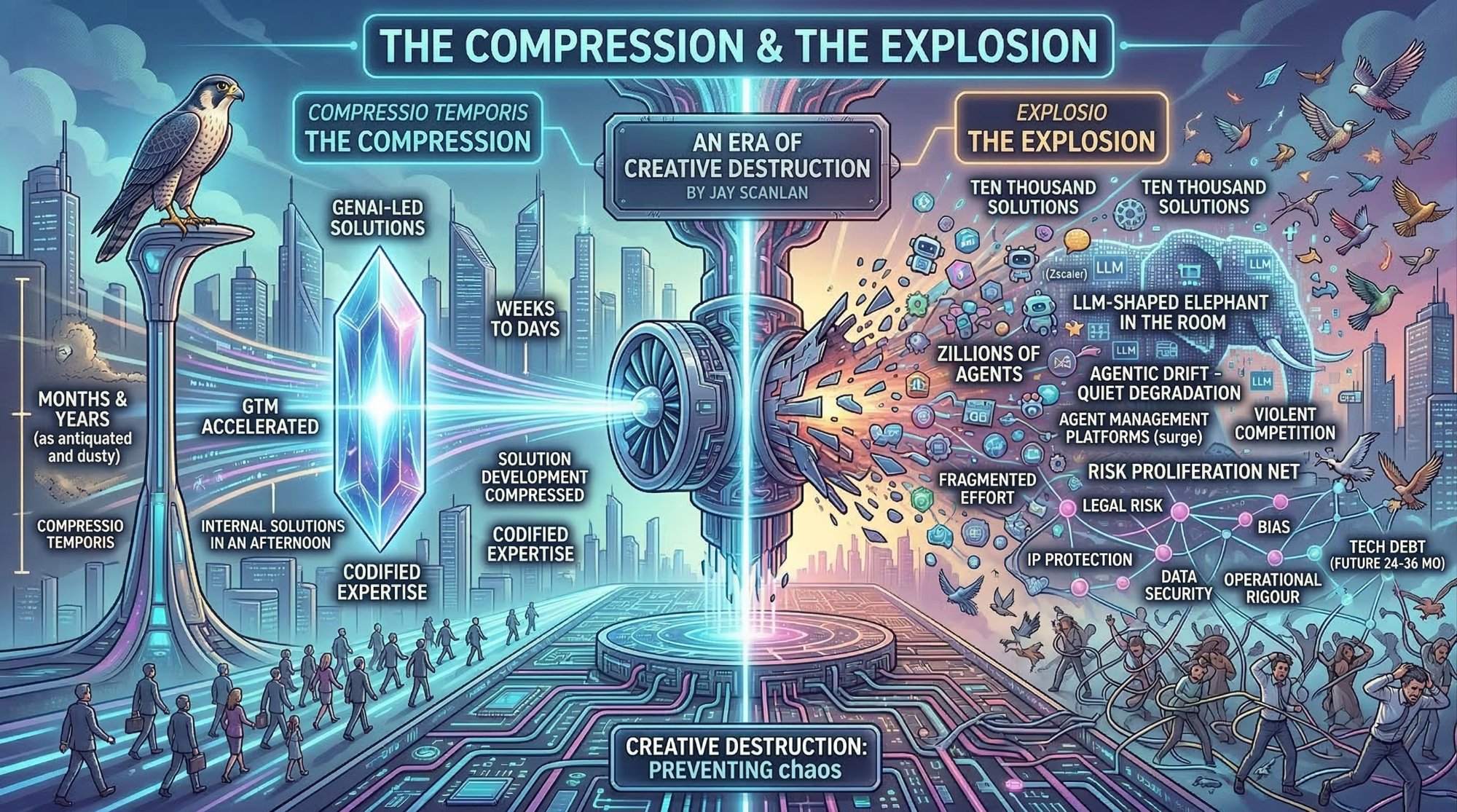
And it's derived from a dualistic belief I have about our new world in PE and enterprise services: The Compression & The Explosion. These two forces, combined, create an era of creative destruction that is probably unprecedented.
So what is this new world? And why did I decide to rebrand this newsletter to these two dual forces?
The Compression
It used to be that in the disordered workflows and processes of cognitively complex work, building new solutions was slow, expensive, and risky. As I mentioned in The Apprenticeship Conundrum, this meant there were precious few builders allowed to survive and thrive in firms. Instead, doing was the paramount virtue: developing clients, delivering impactful client recommendations, recruiting the best possible talent. We did and did and did.
That was then, this is now.
You can build new domain solutions in an afternoon. You can codify decades of expertise and knowledge objects into GenAI-led solutions. You can create diagnostic instruments, frameworks, outside-in / inside-out / hybrid solutions at the snap of a finger (or at least a click into Claude Code).
This compresses everything: space, time, capital, risk. The weeks of internal solution development compressed into days. Sorry, a day, if you're enabled correctly.
Progress is measured in weeks and not years. And the GTM motion is super accelerated. Really, the only thing that slows progress is the change management investment and target operating model transformation required to exploit these new solutions. As I explored in Tools, Tools, Tools, this is the part that nobody budgets for.
The Explosion
In offerings, complexity, risk, competition. In a world where everyone can build, everyone has a solution. The sparse and barren solutions landscape of project-based traditional enterprise services is now flooded. You need a bot to keep up with your firm's bots. And a bot to feed that bot with the latest inventory.
This creates tens of thousands of solutions, accelerators, benchmarks. Zscaler's latest security report tracked over 3,400 distinct AI applications generating enterprise traffic (i.e., nearly 4x the prior year). All of these are living in your ecosystem environment. And each has its own "job description," purpose, deployment model, data needs.
I have yet to see a firm that balances well the creation of these assets with the governance of them, encouraging service innovation without fragmenting effort purposelessly. Worse, it contributes to systemic risk. As we have very recently seen, the quality control, the data security, the data provenance, the safeguarding of standards all get subsumed by firms who have never had to manage these things at scale. Legal risk (competition law, anti-trust, data use rights) becomes a feature not a bug in this new environment.
And none of this even addresses the LLM-shaped elephant in the room: you have to manage this "bot management load" not just today but tomorrow and into the future. As we know, foundational model upgrades (or even cheeky system prompt changes) break or modify the outcomes of these agents in processing tasks.
There's now a name for this: "agentic drift," where systems degrade quietly over weeks and months as underlying models update, data shifts, and business contexts change. Worse still, as our insight into fundamental LLM mechanics deepens, the quality control concerns embedded in these legacy bots become more acute and pressing.
An aside: like many, I have a "skill" that builds other skills, not unlike what Claude released this week. But I send mine into Claude Cowork once a week to scan ArXiv for the newest articles relevant to my use of GenAI and it identifies and internalises improvements to my skill-building bot. So my skill-building semi-automatically improves itself each week based on best academic understanding of LLM behaviour and capability. I don't know many other people that do this as consistent practice.
We all thought "tech debt" used to be an organisational drag. Just wait until we arrive 24 to 36 months from now — it's going to be painful.
One more aside: if there is a platform or system that manages these things well, please drop me a note! Gartner just named "Agent Management Platforms" as a formal category and projects spending will surge from nearly nothing today to $15 billion by 2029. The market clearly agrees we have a problem. Excel macros can create some havoc; GenAI bots can create chaos!
The risks that this new world creates across every dimension (operational rigour, IP protection, bias, data security) are close to unprecedented in industrial technology disruption. The more capable, autonomous, and powerful these agentic capabilities get, the more scope for unintentional or deliberate malfeasance. You thought the "flash crash" was bad — Amazon recently held an emergency engineering meeting after AI-assisted code changes caused a 13-hour AWS outage and then brought down Amazon.com itself for six hours. We haven't seen anything yet.
Last, we will see an explosion of competition. Different layers of offerings and business models will see violent expansion and redistribution of value, market share, and positioning. (I am going to tackle "competitive moats" in a GenAI-intermediated world sometime very soon.)
So welcome to our new world: The Compression & The Explosion.
Expect more on competitive moats, the future of PE in enterprise services, talent, and the strange new economics of a world where building is cheap and governing what you've built is the hard part. I'll also be increasingly welcoming co-authors (friends old and new) who bring perspectives I can't. I know, I know — I need to get back to a more regular cadence. It's been a busy first year out in the field! Stay tuned.
j
Disclaimer: These views are my own and reflect no other organisation. They are current today but likely to evolve rapidly as our world, markets, and technologies do. Comments are welcome but please be constructive and civil. We are all trying to work out answers to this new world together!
Nota Bene: A friend asked me if I write these posts or does an LLM! I write all the words you see above. I do ask an LLM to critique it for me, identify any grammar errors, and fact-check my references. But the words all remain my own.